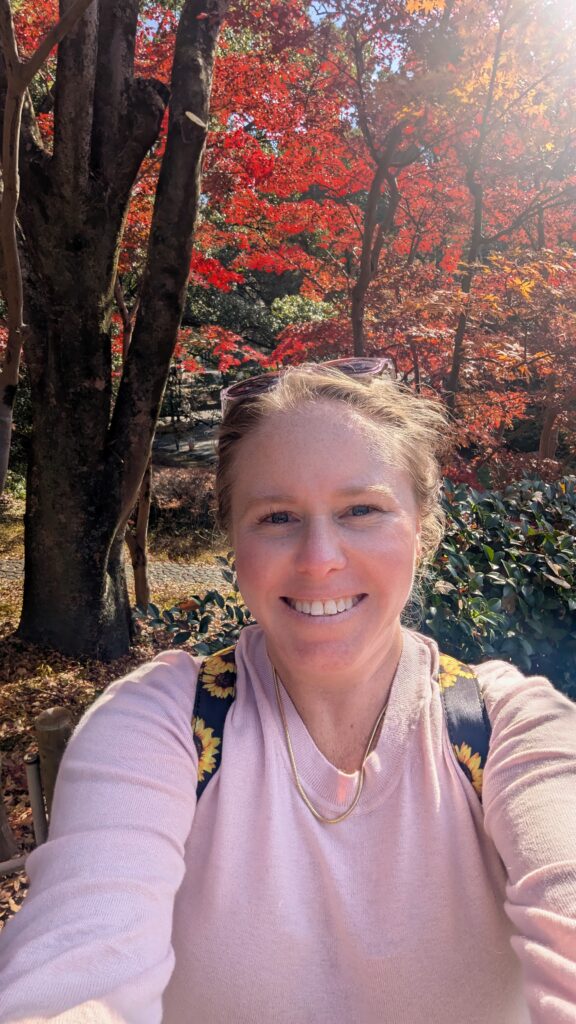
The first thing I really remember about arriving in Germany isn’t the jet lag or the language barrier — it’s the airport window display of lingerie that felt… ambitious. Let’s call it BDSM-esque.
Not exactly easing me into a new country — especially with three kids under six in tow.
Which, honestly, felt appropriate. I mean… I have seen Euro Trip. 😂
Everywhere I looked, there were words I couldn’t decode. Drücken. Imbiss. Ausfahrt. I stared at signs like they were riddles, hoping context clues would save me.
Sometimes they did.
Sometimes I pulled on a door and learned that drücken means push.
Apparently, watching your wife struggle with a glass door is one of Big Man’s favorite forms of entertainment.
I walked around perpetually wide-eyed, trying to look calm while my brain quietly screamed, Where the hell am I, and how am I ever going to make this work?
For a while, I played it safe.
I only shopped on base so I could use American money and buy familiar brands. It felt easier than doing mental math in public or attempting my extremely limited German while holding up a line of very efficient locals who absolutely did not have time for my confusion.
I looked lost because I was lost.
And that part? That’s not a personal failure.
That’s just what it feels like when you arrive somewhere new.
That disoriented, overwhelmed feeling didn’t mean I didn’t belong there. It meant I was new. I hadn’t learned the language yet. I didn’t know which signs mattered, which ones I could ignore, or what “normal” even looked like.
Starting a business feels the same way.
Not in a dramatic, everything-is-on-fire way — but in a why does this seem so easy for everyone else? way.
You’re suddenly surrounded by unfamiliar terms, strong opinions, and rules no one handed you on arrival. Everyone’s pointing in different directions, speaking a language you don’t quite understand yet, and expecting you to pick the right path immediately.
So you default to what feels safest.
You stick close to what’s familiar — not because you’re incapable, but because you don’t yet have enough context to tell what actually matters.
This isn’t hesitation.
Its orientation.
So how do you move forward?
What helped wasn’t trying to understand everything at once. It was picking one thing that felt manageable enough to move us toward our bigger goal: living overseas and traveling as a family.
Before we did anything big, we took a train downtown and wandered around Schlossplatz.
No plan.
No checklist.

Just watching how people moved.
It was in the 90s. People sprawled under trees. Locals sat along the edge of fountains with their shoes off, feet in the water — others waded in fully clothed — like this was completely normal.
We paused.
Looked around.
Did the universal is this allowed? scan.
No one was being arrested.
No one was yelling.
So we took off our shoes and put our feet in the cool water — still half-expecting someone to yell at us.
Was it awkward? Yes.
Did it feel like a small victory? Also yes.
Did anyone else notice? Probably not.
That moment didn’t teach me the rules.
It taught me how to learn them.
Watch.
Try.
Adjust.
Keep going.
A few days later, we drove to Neuschwanstein Castle — because exploring felt less intimidating once we accepted that learning happens through trial and error.

That’s the part people miss when they’re starting a business.
You don’t need the perfect plan before you move.
You need to pick one thing that sounds interesting and moves you closer to where you want to go.
If it sparks curiosity and nudges you forward, it counts.
You’re not committing to a forever decision.
You’re giving yourself enough momentum to learn what comes next.
That’s how confidence actually gets built.
You don’t go from I don’t know what any of this means to confident expert overnight. You go from trying one thing… to trying the next thing that stretches you a little more.
You write the page.
You send the email.
You talk about your offer out loud — even if your voice wobbles.
Each time, you learn what works, what doesn’t, and what feels more like you.
Eventually, you stop Googling every little thing. You stop overthinking every decision. You become the person who knows which doors push and which ones pull — not because you were born knowing, but because you’ve been here before.
And that’s what people mean when they say someone is “good at business.”
They’re not braver.
They’re not smarter.
They’ve just been here longer.
They built trust with themselves one messy, manageable step at a time. And eventually, without realizing it, they become the person others look to and think, Wow, they make this look easy.
Not because it was — but because they stayed long enough to learn what mattered.
If you feel awkward right now, good.
That means you’ve arrived.
I write a weekly email for people in the awkward middle of building something. It’s called The Plot Twist — you’re welcome to join.